
Review methodology: This is a research-based assessment of the LifeStraw Personal Water Filter Straw using the manufacturer’s current product specifications, performance documents, care guidance, and stated limitations. HQ Triply did not conduct independent laboratory or long-term field testing, so filtration claims below are attributed to LifeStraw rather than presented as our own measurements.
As an Amazon Associate I earn from qualifying purchases. If you buy through the Amazon link on this page, HQ Triply may receive a commission at no additional cost to you.
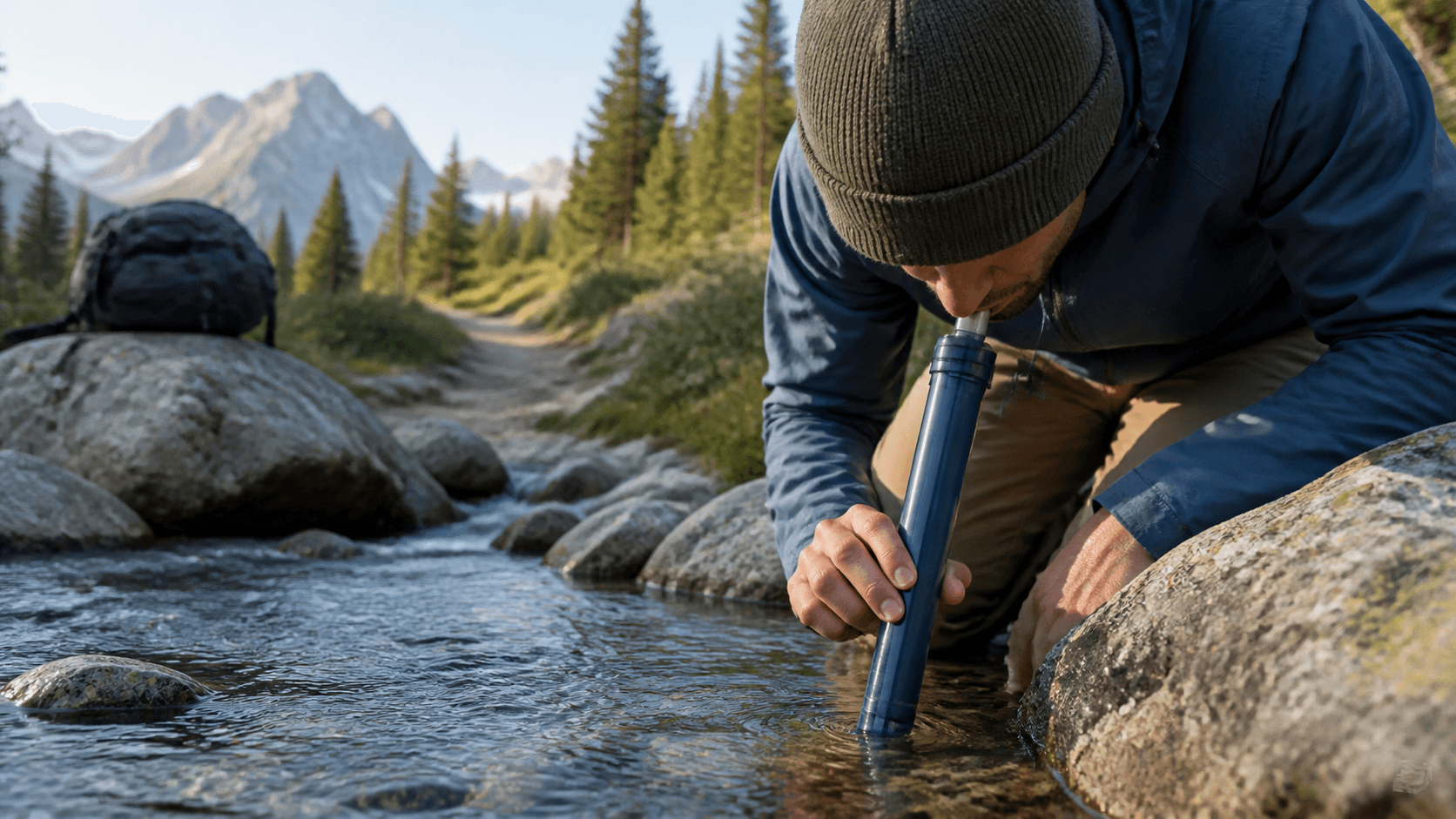
This LifeStraw Personal water filter review looks at a compact filter designed for direct drinking from a freshwater source. Its strongest qualities are low weight, simple operation, and documented protection against bacteria, parasites, and microplastics. Its biggest limitation is equally important: it is a filter straw, not a complete water purifier, and it does not remove viruses, salt, or every chemical contaminant.
LifeStraw Personal Water Filter Review: Quick Verdict
LifeStraw Personal makes the most sense as a lightweight backup for hiking, camping, travel kits, vehicles, and emergency supplies. At a stated 1.6 ounces, it adds little pack weight, requires no batteries, and lets one person drink directly through the filter. The manufacturer says its membrane microfilter lasts up to 1,000 gallons or 4,000 liters, with flow stopping when the filter reaches the end of its service life.
It is less convenient as a primary treatment method for groups, cooking, filling multiple bottles, or situations where water must be carried away from the source. A squeeze, pump, or gravity system is usually easier for processing volume. Travelers concerned about viruses or hikers facing agricultural, industrial, saltwater, or brackish contamination need a treatment method designed for those hazards.
Key Specifications and Filtration Claims
- Dimensions: 9 × 1.2 inches (22.9 × 2.5 cm)
- Weight: 1.6 ounces (46 g)
- Membrane pore size: 0.2 micron
- Stated capacity: up to 1,000 gallons (4,000 liters)
- Includes the filter straw, lanyard, and user manual
- BPA-free materials
- Manufacturer-stated removal: 99.999999% of bacteria
- Manufacturer-stated removal: 99.999% of parasites
- Manufacturer-stated removal: 99.999% of microplastics, dirt, sand, and cloudiness
- Manufacturer states it meets US EPA and NSF P231 criteria for bacteria and parasite removal
Those percentages describe controlled performance claims, not permission to drink from any visible water source. Source selection still matters. Avoid water with suspected chemical spills, mining runoff, fuel, harmful algal blooms, sewage, salt, or brackish conditions. The safest available source should be used, and official land-management or public-health advisories take priority.
How the LifeStraw Personal Works in Practice
The filter uses hollow-fiber membrane technology. Water is drawn through microscopic pores that physically block particles and organisms larger than the pore structure. The direct-drink format removes the need to connect a bottle or carry a pump, but it also puts the user close to the water and does not automatically create a treated reserve for later.
For a short rest beside a reachable stream, that simplicity can be useful. For shallow water, steep banks, silty puddles, winter conditions, or sources that are difficult to approach safely, the straw format can be awkward. Carrying a small clean container can improve access, but the container should not contaminate the clean mouthpiece or other drinking surfaces.
What LifeStraw Personal Does Not Remove
The standard Personal model should not be treated as a virus-removal purifier. LifeStraw’s own guidance distinguishes membrane filters from purifier models intended for virus protection. It also states that its products do not desalinate water, so ocean water, saltwater, and brackish sources are outside the product’s intended protection.
This model also lacks the activated-carbon and ion-exchange stages found in products designed to reduce certain chemicals, metals, odors, or taste. Clear-looking water can still be unsafe, and a filter’s capability must be matched to the likely hazard. When in doubt, consult the product performance sheet and local water guidance rather than relying on appearance.
Is It a Good Hiking Water Filter Straw?
As an emergency water filter for a day hike, the low weight and self-contained design are persuasive. It fits easily into the water-treatment section of a hiking gear checklist and can back up another method if a bottle leaks, a primary filter fails, or a route takes longer than planned. Protective caps help isolate the ends during transport, although the used filter must still be stored and maintained correctly.
For routine backpacking, the answer depends on workflow. People who want to refill bottles, mix meals, share water, or camp away from a source will probably prefer a system that transfers treated water into a container. A solo hiker who values minimum packed weight and expects frequent accessible streams may accept the trade-off.
Cleaning, Storage, and Service Life
Maintenance should follow the current LifeStraw manual. The manufacturer provides separate long-term storage instructions for a used filter that will sit for more than one month. Its current process includes disinfecting, rinsing, and storing the membrane wet in a salt solution so the membrane does not dry out and clog. The exact quantities and steps should be read from the official instructions before storage.
Do not assume an unused and a used filter have the same storage requirements. LifeStraw states the unused product has unlimited shelf life, while the in-use membrane has a stated volume capacity. Hard suction, poor flow, freezing after use, or improper storage should be treated as reasons to stop and consult the manual—not signals to modify or disassemble the unit.
Pros and Cons
Pros
- Very light and compact for backup use
- No batteries, pumping, or separate parts required for direct drinking
- Published performance sheet, user manual, and lab information are available
- High stated capacity for a small filter
- Flow is designed to stop at the end of filter life
Cons
- Does not remove viruses or salt
- Not designed to reduce every chemical or heavy-metal hazard
- Direct-drink format is inconvenient for cooking, groups, and carrying water
- Requires careful cleaning and wet long-term storage after use
- Safe source selection remains essential
Who Should Buy It?
Consider it if you want an ultralight secondary treatment option for a personal hiking kit, roadside emergency bag, travel contingency kit, or disaster-preparedness bin. It is especially easy to justify when you already carry a primary bottle and need a small independent backup rather than a full camp water system.
Choose another format if you regularly treat water for several people, need to fill reservoirs, want faster volume processing, or travel where viruses are a meaningful concern. A product with carbon should be considered when taste and specified chemical reduction matter, while saltwater requires desalination rather than a hiking membrane filter.
Final Verdict
The LifeStraw Personal succeeds as a narrow, lightweight tool: it provides documented membrane filtration in a package small enough to carry as a backup. The product is easy to understand, the official specifications are unusually accessible, and the stated 1.6-ounce weight makes redundancy practical.
It is not a universal answer to unsafe water. Buyers should choose it only when its bacteria, parasite, particle, and microplastic protection matches the expected source. Used within that boundary—and maintained according to the manual—it is a sensible addition to a personal outdoor or emergency kit.